- 1. Iran leverages $189.6B USDT on Tron for sanctions evasion, per Chainalysis 2024 report.
- 2. Dubai VARA enforces surveillance; Gulf compliance costs increase 20-30% annually.
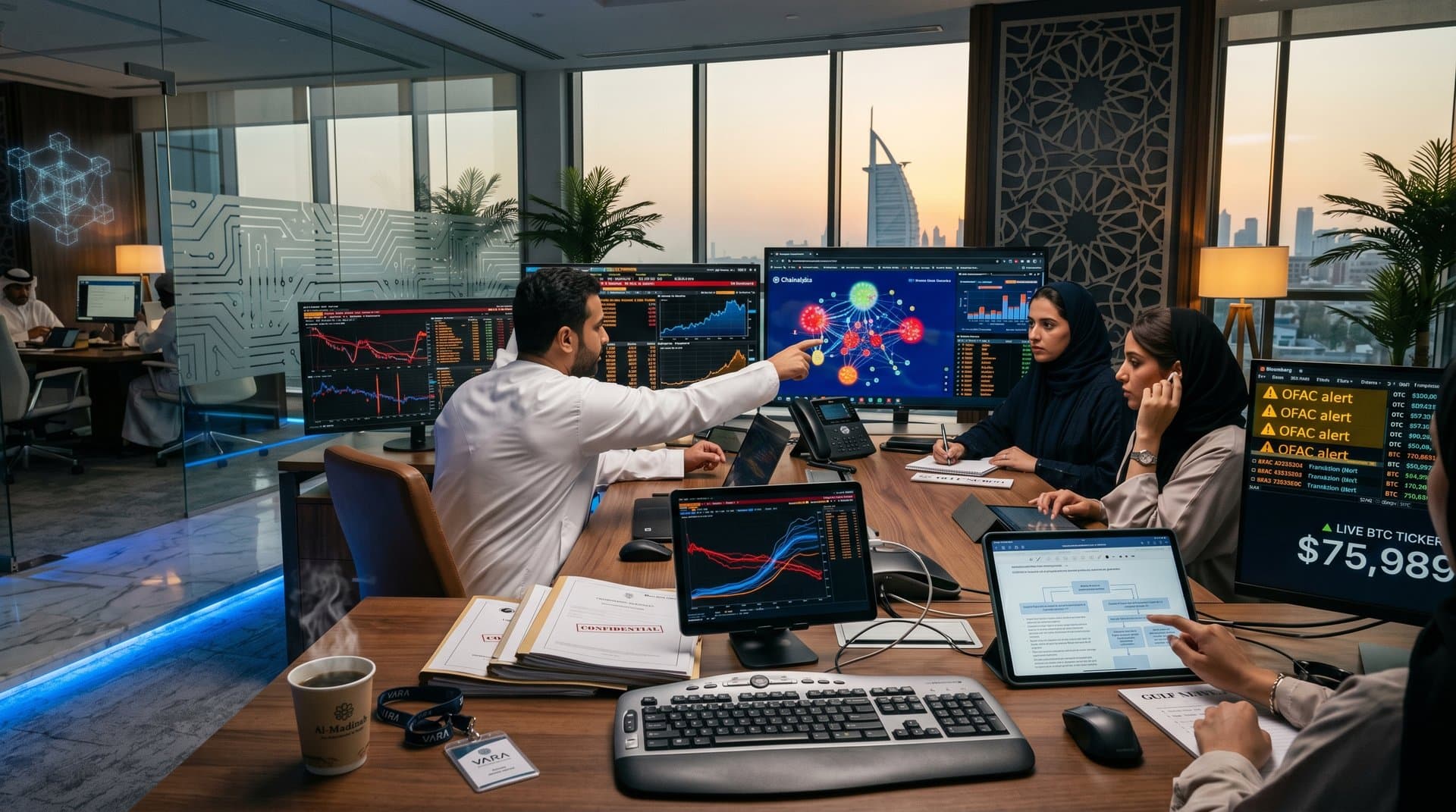
- 3. BTC trades at $75,989 USD; regulators like SAMA and ADGM deploy advanced tools.
Iran deploys $189.6 billion USDT on Tron for crypto sanctions evasion, bypassing US restrictions and reshaping Gulf trade. Dubai's VARA leads regulatory responses with advanced monitoring. Bitcoin trades at $75,989 USD, market cap $1.52 trillion USD. USDT holds $189.6 billion USD market cap.
Chainalysis' 2024 Crypto Crime Report attributes 60% of illicit activity to stablecoins.
Gulf traders confront secondary sanction risks. UAE and Saudi regulators impose tighter controls. Compliance investments accelerate across free zones.
Iran's Crypto Sanctions Evasion Tactics on Tron Network
Iranian entities convert rials to USDT via local exchanges. They bridge funds to Tron for transfers with sub-cent fees. Chinese oil buyers exchange USDT for yuan. Reuters reported this strategy in 2021, highlighting Iran's crypto shift (Reuters report).
Tron (TRX at $0.32 USD, $30.6 billion USD cap) processes transactions in seconds. Dubai ports identify Iranian petrochemical shipments through proxies. Mixers obscure trails, yet USDT volumes remain high.
The US Treasury's OFAC flags virtual currency sanctions evasion in its guidance (OFAC FAQs). Chainalysis clusters Iranian state-linked wallets on Tron.
US Surveillance Tools Track Gulf-Linked Crypto Flows
Chainalysis Reactor software detects Iranian exchange clusters. The firm's 2024 Crypto Crime Report details stablecoins powering 60% of illicit finance (Chainalysis blog). High-velocity USDT on Tron triggers compliance alerts.
Bitcoin's volatility limits its evasion utility. Ethereum trades at $2,276 USD ($274.8 billion USD cap). Mubadala-backed Abu Dhabi fintechs embed Chainalysis APIs for real-time screening.
US Treasury pressures Gulf VASPs to report suspicious activities. OFAC enforcement targets secondary violations in UAE and Saudi hubs.
Dubai VARA Strengthens Blockchain Surveillance Mandates
Dubai's Virtual Assets Regulatory Authority (VARA) mandates exchanges monitor USDT and USDC flows surpassing $77.4 billion USD combined. VARA's stablecoin rules require Know-Your-Transaction (KYT) deployment.
DIFC firms integrate Elliptic tracers for Tron and Solana ($83 USD, $48 billion USD cap). UAE free zone compliance costs rise 20-30% yearly, per VARA filings.
VARA oversees 15% of global compliant crypto volume, according to its 2024 disclosures. ADIA funds surveillance startups through direct investments.
- Asset: USDT · Price (USD): 1.00 · Market Cap (USD): $189.6B · Evasion Role: Primary rail
- Asset: TRX · Price (USD): 0.32 · Market Cap (USD): $30.6B · Evasion Role: Low-cost transfers
- Asset: XRP · Price (USD): 1.37 · Market Cap (USD): $84.2B · Evasion Role: Fast settlement
- Asset: USDC · Price (USD): 1.00 · Market Cap (USD): $77.4B · Evasion Role: Alternative stablecoin
Abu Dhabi ADGM and Saudi SAMA Counter Evasion Efforts
Abu Dhabi's ADGM Financial Services Regulatory Authority (FSRA) licenses VASPs with mandatory Chainalysis integration. UAE Central Bank (CBUAE) requires reports on USDT inflows above $10,000 USD.
Saudi Arabian Monetary Authority (SAMA) tests blockchain oracles for trade verification. Public Investment Fund (PIF) allocates funds to AI tools scanning 1 million transactions daily, as stated in SAMA's 2024 fintech update.
Bahrain Central Bank (CBB) greenlights KYT-equipped exchanges. Qatar Financial Centre (QFC) monitors XRP flows ($84.2 billion USD cap). These measures align with VARA's frameworks.
Gulf Trade Shifts Amid US-Iran Crypto Tensions
Gulf exporters shun flagged USDT addresses. Qatar Airways integrates USDC for payments. Dubai pilots Ethereum-linked CBDC prototypes under VARA oversight.
Riyadh sandboxes DeFi compliance tools via SAMA. Singapore's MAS and EU MiCA regulations shape Gulf standards. VARA targets comprehensive chain coverage by 2027.
Secondary sanctions risk $50 billion USD in annual Gulf-Iran trade, per UAE trade ministry estimates.
Gulf Positions as Global Leaders in Crypto Compliance
US elections may broaden OFAC rules on Tron networks. Iran tests state-backed stablecoins. Gulf hubs pivot to tokenized assets and real-world assets (RWAs).
Fear & Greed Index registers 26, indicating caution. PIF and Mubadala spearhead compliance innovations. Blockchain surveillance investments reach $500 million USD since 2023, according to PitchBook data.
VARA and SAMA establish Gulf crypto hubs as compliance frontrunners. Enhanced tools safeguard trade while fostering fintech growth.
Frequently Asked Questions
How does Iran's crypto sanctions evasion work?
Iran swaps rial for USDT, bridges to Tron for low-fee transfers to oil buyers. $189.6B USD cap sustains liquidity. Gulf KYT flags patterns, per Chainalysis.
What role does USDT play in crypto sanctions evasion?
USDT maintains $1.00 USD peg with $189.6B USD cap. Tron enables fast evasion. Chainalysis traces expose clusters.
How do Gulf states counter crypto sanctions evasion?
VARA mandates USDT monitoring. CBB licenses KYT VASPs. SAMA oracles verify. PIF invests in AI detection.
Why is Tron key in crypto sanctions evasion?
TRX at $0.32 USD ($30.6B USD cap) delivers sub-cent fees, speed. Powers USDT flows. VARA now traces Tron routinely.